
In modern plastic manufacturing, product complexity continues to increase. Components often include undercuts, side features, thin walls, and tight tolerances. Producing these parts consistently requires more than standard tooling — it requires a complex injection mold engineered with precision and reliability in mind.
At JINYI Mould, we specialize in designing and manufacturing precision injection molds capable of handling complicated part geometries and demanding production environments. By combining advanced machining, engineering expertise, and robust mold structures, we help customers move smoothly from prototype to mass production.
This article explores the engineering principles behind a high-precision injection mold, using a real tooling example to illustrate how advanced mold design ensures stable and efficient manufacturing.
What Defines a Complex Injection Mold?
A complex injection mold typically contains multiple functional systems working together to form and release intricate plastic components.
Unlike simple molds, these tools integrate several advanced mechanisms that enable the molding of parts with side holes, internal structures, and undercuts.
Typical features include:
| Feature | Purpose |
|---|---|
| Side sliders | Release undercuts or lateral features |
| Hydraulic cylinders | Provide controlled core pulling force |
| Precision cavities | Ensure tight tolerance and surface quality |
| Cooling channels | Control temperature and cycle time |
| Guided ejection systems | Safely remove molded parts |
The mold shown below is an example of such an engineering solution. Its structure integrates multiple side actions and hydraulic control systems to produce complex plastic components with high repeatability.
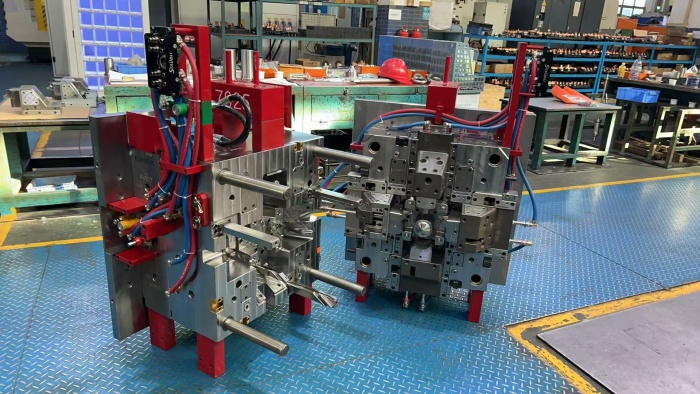
This type of injection mold manufacturing requires careful planning during the design phase to ensure every mechanism works synchronously during the molding cycle.
Key Structural Components of a Precision Injection Mold
Multi-Slider Side Action System
Many plastic parts include features that prevent direct ejection from a standard mold opening direction.
To solve this problem, engineers implement multi-slider mechanisms within the injection mold design.
These sliders move laterally during the mold opening sequence and retract before the part is ejected.
Key advantages include:
Enables complex part geometry
Prevents damage during part release
Maintains dimensional accuracy
Reduces the need for secondary machining
For high-precision products such as automotive housings or industrial components, multi-slider systems are often essential.
Hydraulic Core Pull Mechanism
For large molds or deep side features, hydraulic core pulling systems provide a reliable solution.
Hydraulic cylinders are integrated into the mold base to drive side cores or sliders with controlled force and timing.
Benefits of hydraulic systems include:
Strong and stable actuation
Adjustable stroke length
Smooth motion control
Reduced mechanical wear
These systems are commonly used in precision injection mold manufacturing where mechanical solutions alone may not provide sufficient force or stability.
Precision Mold Cavities
The cavity and core are the most critical parts of any injection mold. Their accuracy directly determines the final product quality.
At JINYI Mould, cavity components are manufactured using a combination of:
High-speed CNC machining
EDM (Electrical Discharge Machining)
Precision grinding
Polishing processes
This ensures that every precision injection mold achieves:
Excellent surface finish
Tight dimensional tolerance
Stable long-term production
Typical cavity tolerances for high-precision molds may reach ±0.01 mm, depending on the application.
Optimized Cooling System
Cooling is one of the most important aspects of injection mold design, yet it is often underestimated.
An effective cooling layout helps maintain uniform mold temperature, which directly affects:
Product warpage
Shrinkage consistency
Surface quality
Production cycle time
A well-designed cooling system can reduce molding cycle time by 20–40%, significantly improving production efficiency.
Engineers at JINYI Mould use simulation tools and practical experience to optimize cooling channel placement during the injection mold manufacturing process.
Typical Production Cycle of an Injection Mold
Understanding the molding cycle helps illustrate how every mechanism inside the mold works together.
A simplified injection molding cycle includes:
| Step | Process |
|---|---|
| 1 | Mold closes |
| 2 | Plastic material is injected into the cavity |
| 3 | Packing and holding pressure applied |
| 4 | Cooling stage |
| 5 | Sliders retract or hydraulic cores move |
| 6 | Mold opens |
| 7 | Ejection system pushes the part out |
Each step must occur in precise timing to ensure smooth production.
Any error in injection mold design may lead to defects such as:
Flash
Short shots
Sink marks
Warpage
Difficult ejection
Engineering Considerations in Injection Mold Design
Designing a reliable complex injection mold requires engineers to consider multiple technical factors.
Part Geometry
The shape of the plastic part determines:
Gate location
Slider direction
Parting line design
Ejection method
Complex geometries often require advanced mold mechanisms.
Material Properties
Different plastics behave differently during injection molding.
For example:
| Material | Key Considerations |
|---|---|
| ABS | Good flowability but shrinkage control required |
| PC | High temperature resistance but higher injection pressure |
| Nylon | Higher shrinkage and moisture sensitivity |
| TPE | Requires careful temperature control |
Material selection strongly influences the injection mold manufacturing process.
Mold Durability
For mass production molds, durability is critical.
Typical production life expectations:
| Mold Type | Expected Lifetime |
|---|---|
| Prototype mold | 10,000 – 50,000 shots |
| Medium production mold | 100,000 – 500,000 shots |
| High volume mold | 1,000,000+ shots |
Choosing the correct mold steel and heat treatment process ensures long tool life.
JINYI Mould’s Capabilities in Injection Mold Manufacturing
With years of experience in injection mold manufacturing, JINYI Mould provides complete tooling solutions from design to production.
Our services include:
✔ Injection mold design and engineering
✔ Mold flow analysis (DFM & Moldflow)
✔ Precision mold manufacturing
✔ Plastic injection molding production
✔ Product assembly and secondary operations
Our molds are widely used in industries such as:
Automotive components
Consumer electronics
Home appliances
Industrial equipment
Medical plastic parts
By combining engineering expertise with advanced manufacturing equipment, we ensure every precision injection mold delivers reliable performance in mass production.
Conclusion
A well-engineered complex injection mold is the foundation of successful plastic product manufacturing.
From multi-slider mechanisms and hydraulic systems to precision cavities and optimized cooling, every detail of the injection mold design contributes to production stability and product quality.
Working with an experienced partner in injection mold manufacturing can significantly reduce development risks and accelerate time-to-market.
If you are developing a new plastic product and need a reliable tooling partner, JINYI Mould is ready to support your project from design to mass production.