

Large automotive bumper molds are among the most challenging tools in automotive injection molding. A bumper is a long, curved, thin-wall exterior component that must meet strict requirements for dimensional accuracy, surface appearance, assembly fit, and production stability.
Warpage and deformation are common problems in large automotive bumper molds. These issues are caused by large part size, long flow distance, uneven wall thickness, complex back-side structures, and unbalanced cooling. A bumper may look acceptable immediately after molding, but dimensional issues can appear during fixture checking, painting, assembly, or final installation.
Controlling warpage in a large automotive bumper mold requires a complete engineering approach from product review to trial mold validation.
Key control areas include:
DFM review
Moldflow analysis
Hot runner and gate design
Cooling system design
Mold rigidity
Balanced ejection
Process control
Dimensional inspection
1. Why Large Automotive Bumpers Are Easy to Warp
Automotive bumpers are more sensitive to warpage than many ordinary plastic parts.
Long flow distance: Melt travels across a large cavity. As the melt moves from the gate to the far end, pressure and temperature gradually change. If filling and packing are not balanced, different areas of the bumper will shrink at different rates, causing bending or twisting.
Complex back-side structures: The front surface requires a smooth Class-A appearance. The back includes ribs, clips, brackets, bosses, reinforcement structures, and sensor-related areas. These create local thickness changes. Uneven cooling can produce deformation.
Thin-wall design: Thin walls reduce weight but are sensitive to pressure, cooling, and ejection forces. Early ejection or uneven cooling may lead to bending or twisting.
Material shrinkage: Materials like PP, PP+EPDM, TPO, ABS, and PC/ABS have different shrinkage rates and thermal properties. Mold design must account for material behavior.
2. Start with DFM Review Before Mold Design
A proper DFM review identifies risks before steel cutting.
Key DFM checks:
| Area | Why It Matters |
|---|---|
| Wall thickness | Sudden changes cause uneven shrinkage |
| Ribs & brackets | Thick or uneven ribs may cause sink marks |
| Mounting points | Clips, holes, bosses affect assembly fit |
| Draft angle | Insufficient draft increases ejection resistance |
| High-risk zones | Must be addressed in gate, cooling, ejection design |
Smooth wall transitions reduce local shrinkage differences. Ribs must be properly sized to support the part without causing stress. Mounting points are critical for assembly fit.
3. Use Moldflow Analysis to Predict Warpage
Moldflow simulation predicts filling, packing, cooling, shrinkage, and warpage.
Benefits:
Identify filling imbalances
Predict weld line and air trap locations
Evaluate warpage direction and magnitude
Optimize gate placement, hot runner layout, cooling channels
Simulation results provide guidance for mold design and reduce trial-and-error. Engineers can adjust gate location, runner size, valve timing, and cooling before steel cutting.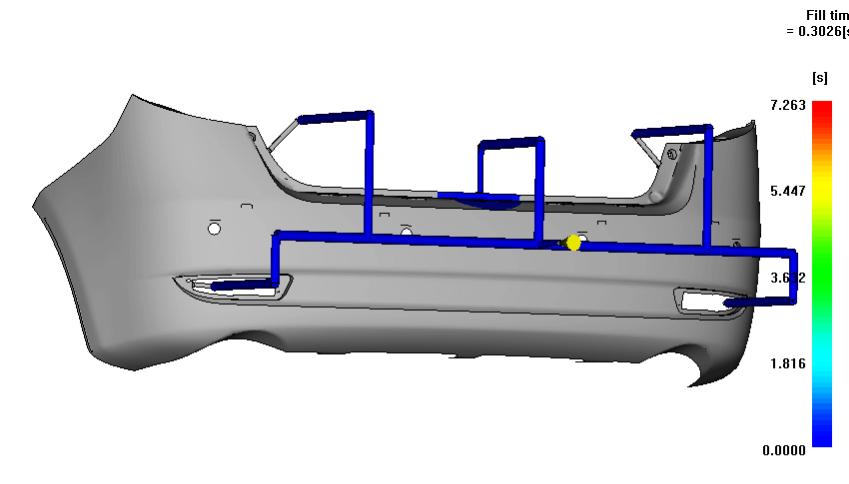
4. Optimize Gate and Hot Runner Design
Gate design influences warpage significantly.
Multi-point or valve gate systems improve filling balance.
Sequential valve control smooths melt front movement, reducing internal stress.
Gate position must balance filling efficiency, surface quality, and dimensional stability.
Incorrect gate placement can lead to uneven packing, weld line issues, and local deformation. Large automotive bumpers require careful gate design due to their length and complex geometry.
5. Cooling System Design Is the Key
Plastic shrinks as it cools. Uneven cooling creates bending, twisting, or local distortion.
Cooling design should focus on:
Thick sections
Rib areas
Brackets and mounting points
Curved surfaces
Long-flow areas
Cavity and core temperature balance
Balanced cooling reduces shrinkage differences. Real-time mold temperature measurement ensures uniformity. Cooling design is more critical for dimensional stability than merely reducing cycle time.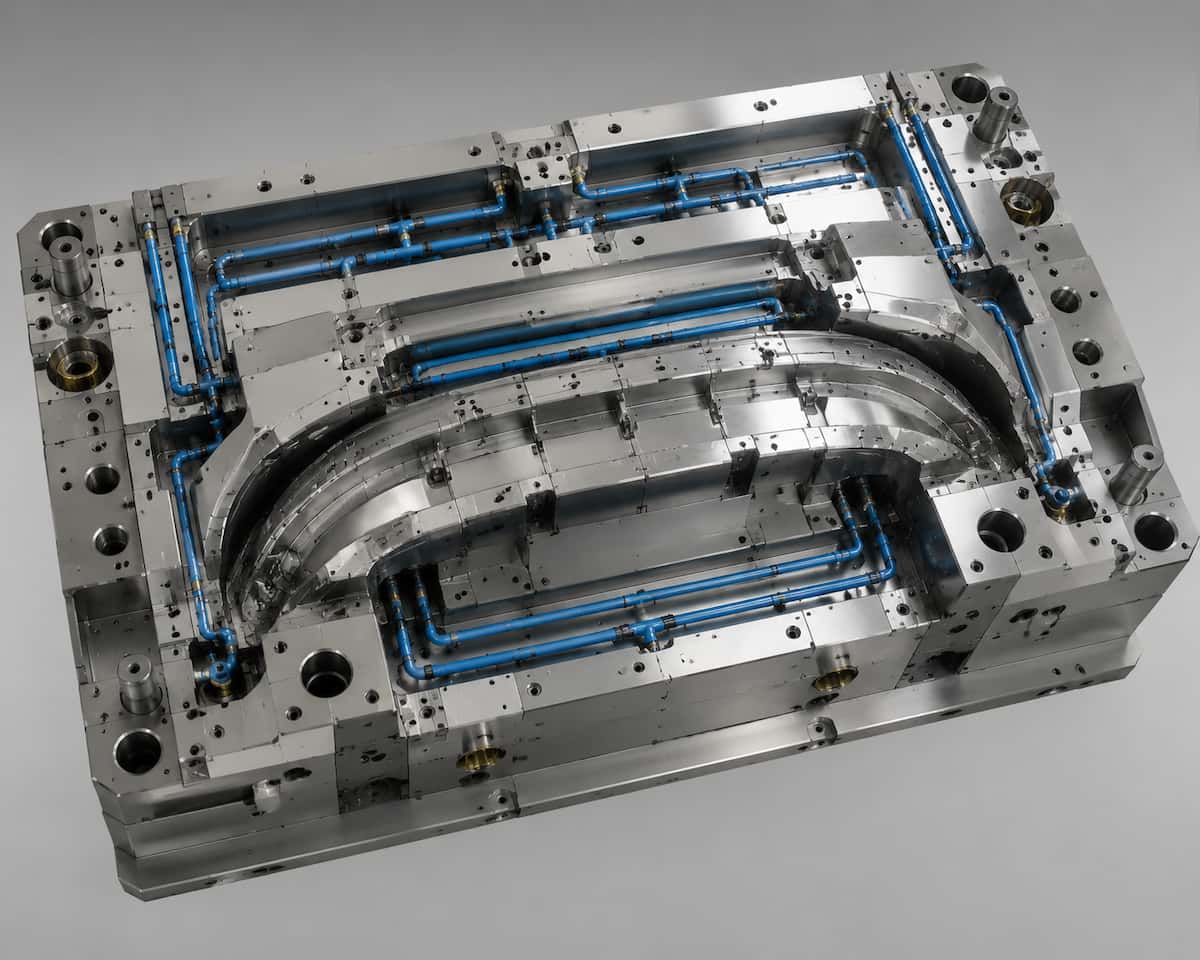
6. Mold Rigidity, Steel Selection, and Machining Accuracy
Large bumper molds are heavy and must withstand clamping forces, injection pressure, and thermal cycles.
Key factors:
Mold base rigidity prevents cavity deformation
Steel selection ensures thermal stability and surface quality
CNC machining maintains wall thickness uniformity
Guide system precision ensures alignment
Parting line fit prevents flash and dimensional variations
Any mismatch or weak mold structure can increase warpage risk.
7. Balanced Ejection and Proper Part Handling
Even with proper filling and cooling, ejection can cause deformation.
Balanced ejection should consider:
Ejector pin distribution
Ejector block support
Lifter movement
Draft angles
Thin-wall area support
Part handling post-ejection
Staged, even ejection prevents bending. Parts must be supported during cooling to avoid gravity-induced warpage.
8. Injection Molding Parameters and Trial Mold Correction
Molding parameters affect warpage:
| Parameter | Influence |
|---|---|
| Melt temperature | Affects flow and shrinkage |
| Mold temperature | Impacts surface quality and shrinkage balance |
| Holding pressure | Controls shrinkage in thick areas |
| Holding time | Affects packing consistency |
| Injection speed | Influences internal stress |
| Cooling time | Determines part rigidity before ejection |
Trial molding (T0–T3) validates filling, ejection, and dimensional stability. CMM inspection ensures key dimensions and assembly fit. Mold corrections are based on measured warpage.
9. Common Mistakes to Avoid
Waiting until T0 trial to address warpage
Focusing only on molding parameters
Ignoring wall thickness transitions
Placing gates without flow consideration
Cooling channels not optimized
Weak mold rigidity
Early ejection
Poor part handling
Relying solely on visual inspection
Correcting mold without measurement data
Early risk identification reduces time and cost. Process settings alone cannot compensate for poor design, unbalanced cooling, or weak mold structures.
Conclusion
Warpage in large automotive bumper molds is caused by multiple connected factors.
A systematic approach ensures consistent results:
Early DFM review
Moldflow analysis for filling, shrinkage, and warpage
Optimized gate, hot runner, and cooling design
Mold rigidity and machining precision
Balanced ejection and proper handling
Data-driven trial mold corrections
The goal is not just a good first sample. A well-designed bumper mold ensures:
Stable dimensions
Reliable assembly fit
Consistent surface quality
Repeatable mass production
Warpage must be controlled from the start, not corrected after it appears.