

Why Edge Cavities Flash in Multi-Cavity Injection Molds (PEEK Case Study)
Solving the Hidden Imbalance in High-Precision Molding
In high-precision injection molding, some defects are not caused by poor processing—but by hidden imbalances that are easy to overlook.
This is especially true when producing PEEK injection molded parts or other engineering plastic parts, where material behavior becomes far more sensitive to temperature, pressure, and flow conditions.
A common example is edge cavity flashing in multi-cavity molds.
The design appears perfectly symmetrical. The runner layout is balanced. Process parameters are stable. And yet, during production, a puzzling pattern emerges: the center cavities produce flawless parts, while the edge cavities consistently show flash along the parting line.
At first glance, this looks like a typical injection molding defect. Increasing clamp force or adjusting temperature seems like a logical solution. However, when these adjustments fail, it becomes clear that the real issue lies deeper—in the interaction between flow behavior and mold structure.
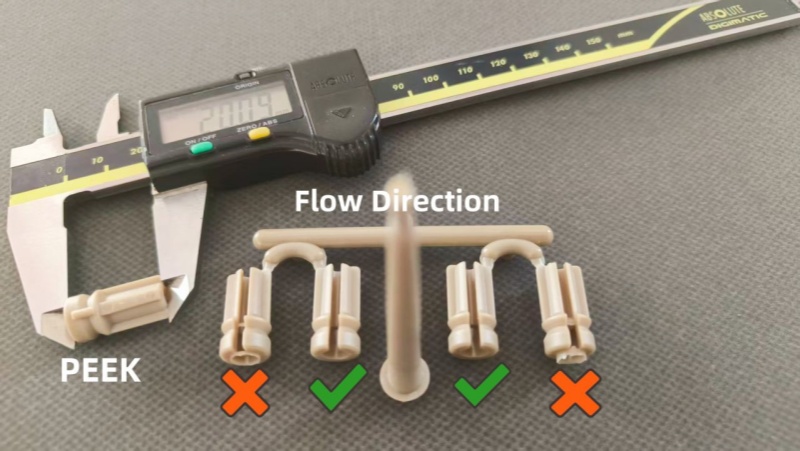
When “Balanced Design” Isn’t Truly Balanced
In theory, a geometrically balanced runner system should ensure equal flow to each cavity. In practice, especially in complex multi-cavity injection mold systems, this assumption often breaks down.
High-performance materials such as PEEK, PPS, and LCP exhibit strong non-Newtonian behavior, meaning their viscosity changes significantly under different shear and temperature conditions. As a result, two flow paths that are identical in geometry may behave very differently during actual injection.
This gap between design and reality is one of the key challenges in modern plastic injection mold design.
The Role of Rheological Imbalance
As molten polymer flows through the runner system, it experiences shear forces that generate heat. This shear heating effect can raise the local melt temperature by 10–30°C before the material reaches the gate.
For materials like PEEK, even a small temperature increase can significantly reduce viscosity, making the melt more fluid and more difficult to control.
In many high temperature plastic mold applications, the melt reaching the outer cavities experiences slightly different shear conditions compared to the center. This results in a hotter, lower-viscosity flow entering those cavities, increasing the likelihood of material escaping through microscopic gaps at the parting line.
Even a gap as small as 0.005 mm can lead to visible flash.
At the same time, lower viscosity does not necessarily mean lower pressure. In fact, easier flow can create localized pressure peaks, sometimes leading to over-packing in edge cavities while the center cavities are still filling normally. This imbalance further increases the risk of flashing.
Structural Deflection and the “Micro-Gap” Effect
Material behavior alone does not explain the issue. The structural response of the mold under pressure is equally important.
During injection molding—especially with high-performance resins—cavity pressure can exceed 140 MPa. Under these conditions, even a robust mold behaves as an elastic system rather than a perfectly rigid structure.
The center area of the mold is typically well-supported, while the outer regions are closer to unsupported edges. This creates a cantilever-like effect, where the mold plates may deflect slightly under load.
Although this deflection is often only 10–30 microns, it is enough to create a temporary gap at the parting line. For highly fluid materials, this gap allows melt to escape, resulting in flash that cannot be eliminated through process adjustments alone.
This is why issues like flashing are not only process-related, but also deeply connected to high precision mold structural design.
Why Trial-and-Error Adjustments Fall Short
When facing flash, the first instinct is often to adjust machine parameters. Increasing clamp force, reducing injection speed, or lowering melt temperature may provide temporary improvement, but these approaches rarely address the root cause.
In fact, they often introduce new risks. Excessive clamp force can lead to uneven stress distribution and accelerated mold wear. Slower injection speeds may cause short shots or surface defects. Lower melt temperatures can increase internal stress and compromise dimensional stability.
Without understanding the underlying imbalance, trial-and-error becomes inefficient and costly.
A Data-Driven Engineering Approach
Resolving edge cavity flashing requires a shift from reactive adjustments to a more systematic engineering approach.
At JINYI Mould, we focus on identifying these risks during the design phase rather than during production.
We use mold flow analysis to evaluate temperature distribution, shear rates, and pressure balance within the runner system. This allows us to fine-tune runner dimensions and achieve true flow balance—not just geometric symmetry.
At the same time, we perform structural analysis to predict how the mold will deform under real injection conditions. By optimizing support pillar placement and reinforcing critical areas, we can minimize deflection and prevent the formation of micro-gaps.
For demanding applications, especially those involving precision plastic components, thermal management strategies can also be applied. Adjusting cooling layouts or controlling temperature distribution between cavities helps stabilize viscosity and reduce flashing risks without compromising part quality.
Conclusion: Bridging Design and Reality
Edge cavity flashing is not a random defect. It is a signal that the mold design has not fully accounted for the combined effects of material behavior, thermal variation, and structural deformation.
Bridging the gap between theoretical design and real-world performance requires more than parameter adjustments. It requires a deeper understanding of how materials flow and how molds respond under pressure.
By adopting a data-driven approach, manufacturers can achieve more stable production, reduce defects, and ensure consistent quality in complex molding applications.
💬 Let’s Talk
If you are working with engineering plastic parts or developing new multi-cavity injection mold projects, addressing these challenges early can save significant time and cost.
Feel free to reach out for technical discussion or support.
Contact Us for Inquiries
Marketing: Selina Chan
WhatsApp: +86 18969686504
Email: selina@jy-mould.com
Contact us to discuss how we can support your project needs.