

Detailed Process Overview for Silicone Mold Casting of Film-Coated Products
In the manufacturing of specialized components, especially for medical and industrial sectors, medical silicone casting components play a critical role in delivering flexibility, durability, and precision. The production of film-coated parts involves several advanced processes, ensuring that the final products meet stringent quality and performance standards.
The process begins with the creation of a highly accurate master model, typically using a 3D printed master + silicone mold process. Leveraging advanced 3D printing technology allows for rapid prototyping with fine detail reproduction, which is essential for developing intricate designs and complex geometries. This master serves as the foundation for creating the first silicone mold, ensuring that every subsequent part maintains the same high level of precision.
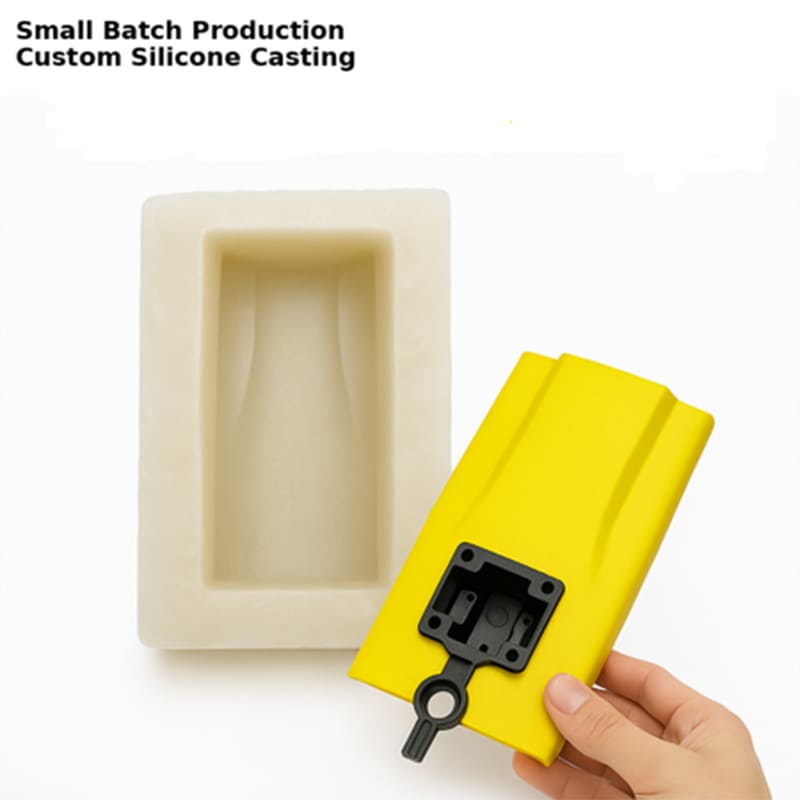
After preparing the master model, the flexible silicone mold casting for parts technique is used to fabricate the working molds. Room-temperature vulcanizing (RTV) silicone is poured over the master part, capturing every minute surface detail. Once cured, the silicone mold offers excellent flexibility and durability, making it ideal for producing components with undercuts, thin walls, and delicate structures. This step is especially vital when manufacturing medical silicone casting components where biocompatibility and structural accuracy are non-negotiable.
For production runs requiring high accuracy and fast turnaround times, silicone mold casting for small batch production becomes the preferred solution. Compared to traditional steel mold fabrication, silicone mold casting dramatically reduces lead time and initial tooling costs, making it ideal for prototypes, pre-production validation, and small-volume manufacturing. The molds can be reused multiple times while maintaining dimensional stability and surface quality.
Throughout the process, the role of a high-precision silicone casting manufacturer is indispensable. Expertise in mold design, material selection, and casting techniques ensures that each batch of medical silicone casting components adheres to strict international standards. Key aspects such as material hardness, tensile strength, and biocompatibility are carefully controlled to meet specific customer requirements, especially for applications in diagnostics, wearable medical devices, and minimally invasive surgical tools.
In addition to medical uses, the 3D printed master + silicone mold process is widely adopted for consumer electronics casings, automotive interior parts, and aerospace components. This technique provides manufacturers with the flexibility to iterate designs rapidly and bring products to market faster. Flexible silicone mold casting for parts also allows for variations in material properties, enabling customization in terms of color, hardness, and surface texture.
Moreover, silicone mold casting for small batch production ensures that customers can conduct functional testing and early market trials without the financial risk associated with high-volume tooling. It bridges the gap between prototype development and mass production, providing a scalable and cost-effective solution tailored to specific project needs.
By partnering with a high-precision silicone casting manufacturer, companies gain access to a full spectrum of services from mold fabrication, material consultation, prototype validation, to small batch delivery. This end-to-end capability significantly shortens development cycles and enhances product competitiveness.
In conclusion, the combination of 3D printed master + silicone mold process, advanced RTV techniques, and expertise in flexible silicone mold casting for parts has redefined modern manufacturing workflows for customized components. The ability to produce highly accurate, functional, and visually appealing parts reinforces the importance of medical silicone casting components and silicone mold casting for small batch production in today's rapidly evolving industries.