

Understanding the Micro-Mechanism of Stress Cracking in High-Cavity Injection Molds for PC/ABS Parts
In injection molding, mold failure is often misunderstood as a problem of design precision or machining quality. However, in high-volume production—especially in High-Cavity Injection Molds—many failures are not structural mistakes, but the result of accumulated material physics over time.
At JIN YI MOULD, we approach mold performance from a different angle: not just how to build a mold that works on day one, but why it fails after thousands of cycles.
This article explores the micro-mechanisms behind stress cracking in PC/ABS parts, and how residual stress, thermal behavior, and mold design interact to create long-term instability.
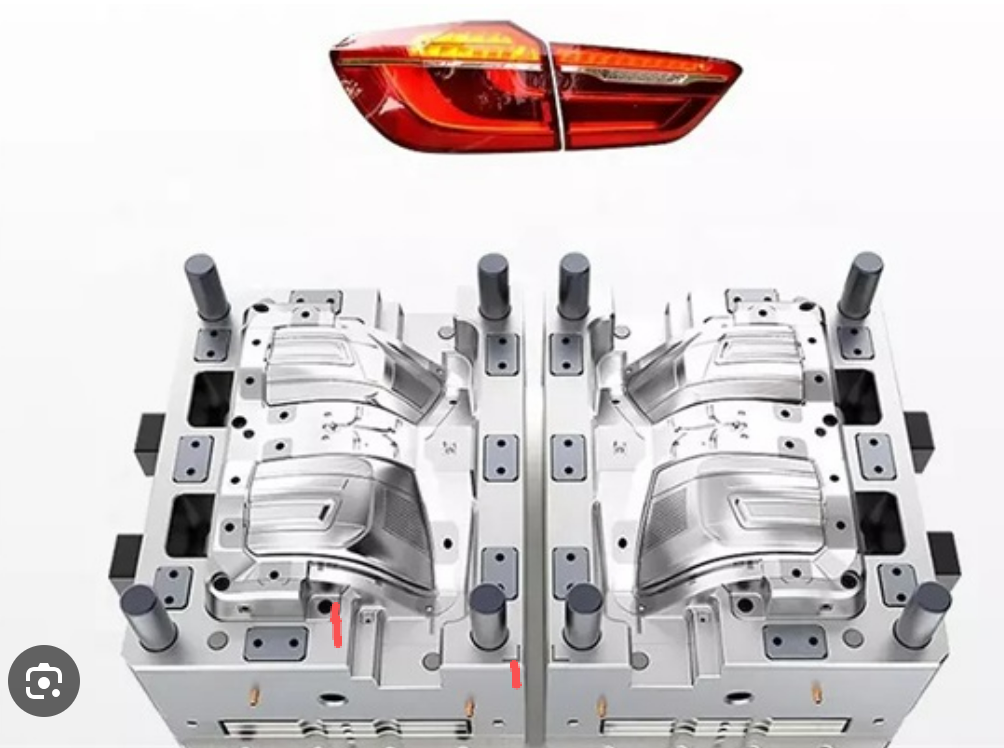
1. Why High-Cavity Injection Molds Fail in Silence
In multi-cavity production, small inconsistencies are amplified across every cycle. A mold with 8, 16, or 32 cavities does not fail abruptly—it degrades gradually and unevenly.
The key issue is that High-Cavity Injection Molds introduce inherent variability:
Slight flow imbalance between cavities
Uneven cooling efficiency
Localized pressure and temperature differences
Accumulated cycle-to-cycle variation
These micro-variations do not immediately affect part appearance. Instead, they create internal stress conditions that slowly build toward failure.
In PC/ABS applications, this becomes especially critical due to the material’s sensitivity to internal stress accumulation and thermal history.
2. Residual Stress in Injection Molding: The Invisible Structure Inside the Part
One of the most important but least visible factors in mold performance is Residual Stress in Injection Molding.
Residual stress is the internal energy locked inside a molded part after cooling. It is not visible, but it determines long-term behavior.
In PC/ABS materials, residual stress is mainly generated from three sources:
Molecular orientation during high-speed filling
Non-uniform cooling rates across the cavity
Pressure imbalance during packing and holding stages
In high-cavity molds, these effects are amplified due to:
Slight differences in flow resistance per cavity
Cooling channel asymmetry
Temperature drift across mold plates
Over time, this internal stress does not disappear—it redistributes. And that redistribution is what eventually leads to cracking.
3. Thermal Gradient and Loss of Material Strength Over Cycles
In real production environments, molds never operate under perfectly stable thermal conditions.
Local temperature differences—known as thermal gradients—are unavoidable. These gradients come from:
Cooling channel layout limitations
Hot spots near thick sections
Cycle time fluctuations
Uneven heat extraction efficiency
Instead of describing this simply as “hardness reduction,” it is more accurate to describe the phenomenon as:
Loss of yield strength at elevated temperatures under cyclic thermal loading
For PC/ABS materials, repeated heating and cooling cycles lead to:
Reduced resistance to deformation under stress
Accelerated molecular relaxation
Increased sensitivity to residual stress release
The material does not fail immediately. It weakens progressively under thermal cycling, especially in areas where residual stress is already high.
4. PC/ABS Stress Cracking: How Micro-Cracks Begin
PC/ABS Stress Cracking is not a sudden failure event. It is a progressive micro-scale fracture process.
The mechanism typically follows this sequence:
Residual stress is locked into the part during molding
Thermal cycling during use or post-molding storage causes stress redistribution
Micro-voids form in high-stress regions
These voids evolve into micro-cracks
Cracks propagate under repeated environmental or mechanical loading
The key insight is this:
Crack initiation happens long before visible damage appears.
By the time a crack is visible, the internal failure mechanism has already been active for thousands of cycles.
5. Mold Venting Optimization: Controlling Hidden Thermal and Pressure Effects
While often treated as a secondary design detail, Mold Venting Optimization plays a direct role in stress formation.
Poor venting leads to:
Gas compression during filling
Localized temperature spikes
Material degradation at flow fronts
Uneven packing pressure distribution
In PC/ABS molding, these effects are particularly harmful because the material is sensitive to:
Thermal overheating at micro-scale regions
Local pressure concentration
Surface-level molecular degradation
Proper venting design is therefore not just about avoiding burn marks—it is about controlling local stress generation conditions.
At JIN YI MOULD, venting is treated as a stress-control mechanism, not just a gas-release feature.
6. JIN YI Perspective: Engineering Against Physical Fatigue in High-Cavity Molds
At JIN YI MOULD, we do not only focus on mold manufacturing accuracy. We focus on long-term physical stability under real production conditions.
6.1 Mold Temperature Control as a Stress Management System
Instead of treating mold temperature as a fixed value, we treat it as a distributed system.
Multi-zone temperature control
Local thermal balancing across cavities
Reduction of thermal gradient between core and cavity
This directly reduces residual stress formation during solidification.
6.2 Flow-Cooling Co-Design for Stability
Using mold flow analysis and DFM validation, we evaluate:
Flow path symmetry
Cooling efficiency per cavity
Predicted residual stress distribution
This allows us to correct imbalance before tooling is finalized, not after defects appear.
6.3 Precision Mold Manufacturing for Long-Term Stability
For us, Precision Mold Manufacturing is not only about dimensional tolerance.
It includes:
Thermal consistency over cycles
Mechanical stability under repeated loading
Controlled deformation behavior of the part over time
Precision is defined by stability, not just measurement.
6.4 Post-Molding Dimensional Stability Analysis (CMM-Driven)
One of the most critical but often overlooked aspects of mold validation is what happens after demolding.
A molded part does not reach its final state immediately. It continues to deform as internal stresses relax.
To capture this behavior, JIN YI MOULD uses CMM (Coordinate Measuring Machine) for time-based analysis:
Measurement at 0 hours (immediate demolding condition)
Measurement at 24 hours (initial stress relaxation phase)
Measurement at 48 hours (stabilization phase)
This allows us to observe warpage evolution over time, which is a direct manifestation of residual stress release.
Instead of only checking whether a part is “in tolerance,” we evaluate:
How stable the geometry remains after stress redistribution.
The results are then fed back into mold optimization, especially in:
Cooling system adjustment
Cavity balance refinement
Stress reduction strategy development
This closes the loop between measurement and mold design.
7. Conclusion: Mold Failure Is a Time-Dependent Material Phenomenon
The failure of PC/ABS parts in high-cavity molds is not a sudden event. It is the result of accumulated physical processes over time:
Residual stress accumulation
Thermal gradient exposure
Cyclic thermal fatigue
Micro-crack initiation and propagation
Understanding mold failure requires shifting from a static perspective to a time-based material behavior model.
At JIN YI MOULD, we design not only for dimensional accuracy, but for long-term structural and material stability under real production cycles.
Final Thought
Precision mold manufacturing is not about making parts that fit—it is about ensuring they remain stable throughout their lifecycle.
Contact Us for Inquiries
Marketing: Selina Chan
WhatsApp: +86 18969686504
Email: selina@jy-mould.com
Contact us to discuss how we can support your project needs.