
Multi-Cavity vs Family Mold: Which One Saves More Cost?
In the world of injection molding, choosing the right mold type can make or break your cost structure and production efficiency. For procurement managers, understanding the trade-offs between a multi cavity mold and a family mold design is critical to achieve injection mold cost optimization while maintaining high plastic mold production efficiency.
This article dives deep into the definitions, advantages, disadvantages, and ideal applications of these two common mold types, providing a clear guide to make informed purchasing decisions.
1. What is a Multi-Cavity Mold?
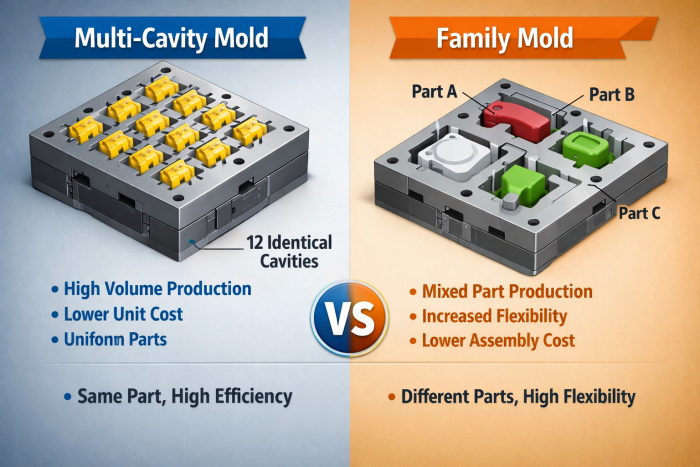
A multi-cavity mold contains multiple identical cavities within a single mold. Each injection molding cycle produces several identical parts simultaneously.
Advantages:
High Production Efficiency: Produces multiple parts per cycle, reducing cycle time for large volumes.
Lower Unit Cost: High output allows mold costs to be spread over more parts, reducing per-unit cost.
Consistency: All parts are identical, making quality control simpler and more predictable.
Disadvantages:
High Initial Mold Cost: Designing and manufacturing multiple cavities increases upfront investment.
Reduced Flexibility: Design changes require modifications to all cavities, making updates slower.
Machine Requirements: Requires injection molding machines with sufficient tonnage and consistent performance.
Ideal Applications:
Large-volume production of identical parts such as bottle caps, electronic housings, buttons, or fasteners.
2. What is a Family Mold Design?
A family mold design integrates multiple different cavities into a single mold. Each cycle produces a set of different parts, which together may form a complete assembly or kit.
Advantages:
Reduces Assembly Costs: Different parts produced in one cycle minimize the need for post-molding assembly.
High Flexibility: Ideal for small batches or product variations with multiple components.
Lower Inventory Pressure: Simultaneous production of multiple parts allows for better stock management.
Disadvantages:
Lower Production Efficiency: Fewer parts per cycle compared to a multi-cavity mold, leading to higher unit costs.
Complex Mold Design: Balancing the flow and filling for different cavities requires precision engineering.
Dimensional Consistency Challenges: Different shrinkage rates and part geometries require careful design.
Ideal Applications:
Small batch production of multi-component kits such as toys, electronic kits, medical device components, or household appliance sets.
3. Cost Comparison: Multi-Cavity Mold vs Family Mold Design
When considering injection molding cost optimization, the decision between a multi-cavity mold and a family mold design depends on production volume, assembly requirements, and flexibility needs.
| Mold Type | Initial Mold Cost | Unit Cost | Production Flexibility | Recommended Scenario |
|---|---|---|---|---|
| Multi-Cavity Mold | High | Low (economies of scale) | Low | Large-volume, identical parts |
| Family Mold Design | Medium | Medium-High (small batch) | High | Multi-component kits, small-volume production |
Key Takeaways:
For large-volume production, a multi-cavity mold typically provides the best injection moldingcost reduction.
For small batches, diverse product sets, or kits, a family mold design offers higher efficiency and reduces assembly and inventory costs.
4. Factors Procurement Managers Should Consider
Production Volume vs Unit Cost:
Determine if the quantity of parts justifies a high upfront mold cost (multi-cavity) or benefits from flexibility (family mold).Product Update Frequency:
If product designs change frequently, family mold design allows faster iterations.Injection Molding Machine Capacity:
Multi-cavity molds require machines capable of higher tonnage and consistent injection performance.Overall Supply Chain Cost:
Consider assembly, inventory, and logistics. Family molds can reduce post-production assembly, simplifying the supply chain.Quality Requirements:
Multi-cavity molds ensure dimensional consistency across identical parts, while family molds may require more precise flow and shrinkage control.
5. Technical Considerations in Mold Design
Flow Balance: Family molds need careful balancing of gates and runners to ensure even filling.
Cooling System: Multi-cavity molds require uniform cooling to prevent warpage; family molds require customized cooling channels for different parts.
Material Selection: Consistent material properties are critical for both mold types to achieve repeatable quality.
Cycle Time Optimization: Multi-cavity molds reduce cycle time per part; family molds reduce total assembly time.
6. Practical Examples
Multi-Cavity Mold Example: A 16-cavity mold producing identical snap-fit connectors for electronics. Each injection cycle produces 16 connectors, significantly lowering unit costs for high-volume orders.
Family Mold Design Example: A household appliance kit containing three different parts: a handle, a cover, and a button. One cycle produces a complete set ready for assembly, reducing labor and inventory handling.
7. Injection Mold Cost Optimization Strategy
When optimizing injection molding cost, consider:
Mold Type Selection: Align mold choice with production volume and product complexity.
Cycle Efficiency: Reduce downtime between cycles with proper mold maintenance.
Material Utilization: Minimize scrap with precise flow simulation and plastic mold production efficiency techniques.
Outsourcing vs In-House Production: Balance mold investment against manufacturing flexibility.
Quality Control Integration: Early mold trials ensure consistent quality and reduce waste.
8. Summary
| Decision Factor | Multi-Cavity Mold | Family Mold Design |
|---|---|---|
| Production Volume | High | Low to Medium |
| Unit Cost | Low | Medium-High |
| Assembly Requirement | High (separate) | Low (simultaneous) |
| Flexibility | Low | High |
| Ideal Use Case | Mass production of identical parts | Small batches, multi-component kits |
Choosing between a multi-cavity mold and a family mold design requires balancing production volume, assembly efficiency, flexibility, and upfront cost. By understanding these trade-offs, procurement managers can make informed decisions that maximize plastic mold production efficiency while minimizing injection molding cost.
9. Conclusion
For procurement teams, investing time in evaluating mold types is crucial. While multi-cavity molds are ideal for high-volume, cost-sensitive production, family molds excel in flexible, multi-part small-batch scenarios. Properly selecting the mold type aligns production strategy with cost optimization, quality, and operational efficiency.