
Why Understanding the Mold Timeline Matters
When starting a new project, one of the first questions customers ask is:
“What is the mold lead time?”
However, a reliable answer requires understanding the full injection mold timeline, not just a rough estimate.
A well-managed mold project timeline helps you:
Plan your product launch with confidence
Avoid costly delays and redesigns
Evaluate whether a supplier is truly experienced
In reality, delays rarely come from machining itself — they come from poor planning in the earlier stages of the injection mold process.
Overview: A Typical Mold Timeline at a Glance
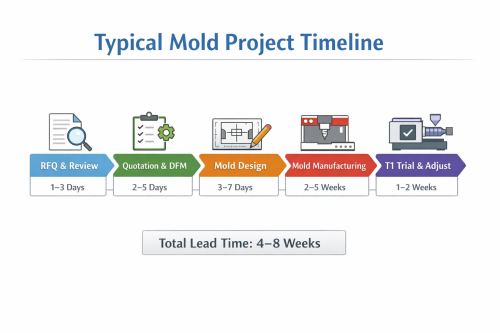
Below is a general overview of a standard mold manufacturing process timeline:
| Stage | Description | Typical Duration |
| RFQ & Review | Drawing analysis, feasibility check | 1–3 days |
| Quotation & DFM | Cost breakdown + design suggestions | 2–5 days |
| Mold Design | Full mold structure design | 3–7 days |
| Mold Manufacturing | CNC, EDM, assembly | 2–5 weeks |
| Assembly & Testing | Mold fitting and inspection | 2–5 days |
| T1 Trial | First sample validation | 1–3 days |
| Optimization | Adjustments if needed | 3–10 days |
👉 Total typical mold lead time: 4–8 weeks
1. RFQ & Technical Review — The Foundation of Everything
Every successful mold manufacturing process starts with a proper RFQ stage.
At this point:
3D files (STEP/IGES) are reviewed
Undercuts, wall thickness, and draft angles are checked
Potential risks are identified early
👉 Many delays in the injection mold timeline originate here — when issues are not identified early.
2. Quotation & DFM — Where Costs and Risks Are Defined
This stage is often underestimated, but it has a major impact on both cost and mold lead time.
A proper DFM report should include:
Gate location proposal
Parting line definition
Ejection method
Potential deformation risks
👉 A strong DFM can reduce trial iterations and stabilize the entire mold project timeline.
3. Mold Design — The Most Critical Decision Stage
Once the order is confirmed, detailed mold design begins.
This includes:
Core & cavity layout
Cooling channel design
Runner system (hot or cold)
Slider/lifter mechanisms
💡 Important insight:
Design mistakes at this stage are the most expensive to fix later.
That’s why experienced suppliers invest more time here — to shorten the overall injection mold process.
4. Mold Manufacturing — The Longest Phase
This is the most time-consuming part of the mold manufacturing process, where the mold becomes a physical tool.
Key Processes Involved:
| Process | Purpose |
|---|---|
| CNC Machining | Rough and finish cutting of mold base and inserts |
| EDM (Electrical Discharge Machining) | Precision features and sharp corners |
| Drilling & Tapping | Cooling channels and assembly holes |
| Heat Treatment | Improve hardness and durability |
| Grinding & Polishing | Surface finish and precision |
👉 The complexity of the product directly affects this stage and the overall mold lead time.
5. Mold Assembly & Internal Inspection
Once all components are ready:
Mold is assembled
Alignment and fitting are checked
Movement of sliders/lifters is tested
This stage ensures the mold is ready for the first trial without major risks.
👉 Skipping detail here often leads to delays in the injection mold timeline during trial.
6. T1 Trial — First Real Validation
The T1 trial is a critical milestone in the mold project timeline.
At this stage:
First samples are produced
Dimensional inspection is conducted
Surface defects are evaluated
Typical Checks:
| Check Item | Purpose |
|---|---|
| Dimensions | Ensure part meets tolerance |
| Appearance | Surface quality, sink marks, flash |
| Warpage | Structural stability |
| Fit & Assembly | Functional validation |
👉 Very few molds are perfect at T1 — optimization is usually required.
7. Optimization & Additional Trials (T2, T3)
If issues are found:
Mold steel may be modified
Cooling may be improved
Process parameters adjusted
👉 This phase can extend the mold lead time, especially if early DFM was insufficient.
What Actually Delays a Mold Project Timeline?
Even with a clear injection mold timeline, delays can still happen.
Common Causes:
Incomplete or unclear product design
Late design changes from customer
Poor DFM analysis
Complex mold structures (multiple sliders, lifters)
Communication delays between teams
👉 In most cases, delays are not caused by machining — but by decision-making.
How to Shorten Mold Lead Time (Practical Tips)
If you want to reduce your mold lead time, focus on these:
Provide complete 3D data from the beginning
Confirm DFM quickly
Avoid late-stage design changes
Choose a supplier with in-house capabilities
Ensure fast communication
Conclusion: A Controlled Timeline Is a Reliable Timeline
A successful injection mold timeline is not just about speed — it’s about control, experience, and communication.
At JINYI MOULD, we focus on:
Early-stage DFM accuracy
Structured mold design workflow
Stable and transparent mold manufacturing process
This ensures every mold project timeline is predictable, efficient, and aligned with your production goals.